




Cadastral Services
Cadastral surveying is the definition of land boundaries by the application of survey procedures and exercise of judgment in accordance with precedent and statute law (Land Survey Act 20:12). It includes surveys for the subdivision, consolidation alienation, resumption, amendment of title and other dealings in land and interests in land.

Land Surveying
A survey is a process carried out by a registered surveyor and involves the measurement and placement of marks (often called pegs, but not all marks placed by surveyors are pegs) on points of the earth’s surface to show the position of existing and new land boundaries. Cadastral surveying and mapping is carried out by a cadastral surveyor, who must adhere to both legal and spatial-measurement principles in physically determining the boundaries of real property. Cadastral surveyors cross reference deeds, maps of the adjoining properties, county and utility maps, survey records, and other legal documents establishing property boundaries. The SG office provide and maintain these cadastral data and offer cadastral surveying services.
Why have land surveyed?
Parcels of land (also known as lots) are surveyed for many reasons, including:

To mark the accurate position of the legal boundary for an existing property.
To create new lot boundaries because of a subdivision.
To define an area within a parcel of land that may be burdened or benefited by a registered servitude or other interest.

Prospective home buyers and property owners have the opportunity to access survey records relevant to their property, empowering them to carefully examine potential concerns regarding property boundaries and existing restrictions. This process ensures a thorough comprehension of their property's status and any possible limitations it may entail.

What is a Cadastre?
A Cadastre serves as a thorough land recording system, encompassing information regarding land parcels, boundaries, and all legally recognized land entities as stipulated by law. Utilized for recording, managing, upholding land ownership as well as property rights, a Cadastre plays a crucial role in maintaining accurate and organized land records.
Property transactions: Cadastral information is used to verify property ownership and to facilitate property transactions.
Taxation: Cadastral information is used to assess property taxes.
Planning and development: Cadastral information is used to plan and develop land.
Environmental protection: Cadastral information is used to protect the environment by tracking land use and development.
What is eCadastre?
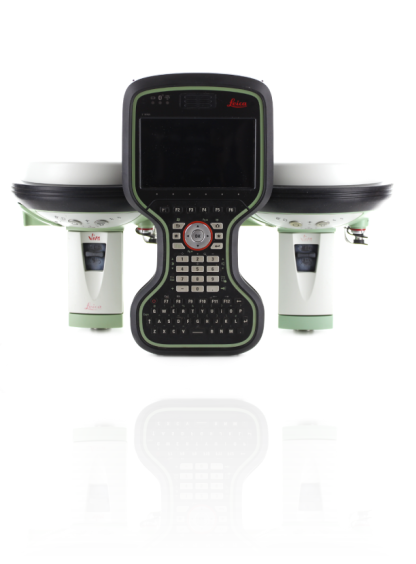
The Electronic Cadastre stands as a beacon of modernity and innovation in the realm of recording and overseeing land information, leveraging the capabilities of digital technology. Its comprehensive functionality extends to facilitating seamless access, efficient retrieval, and timely updates of land data,
culminating in heightened transparency and efficacy within land administration processes.
Serving as the primary access point to the Zimbabwe land records, it serves as the foundational pillar of a robust land administration system. The influence of the Electronic Cadastre permeates various facets of land management, including but not limited to title registration, land valuation procedures, conflict resolution mechanisms, and the execution of diverse surveying tasks, all contributing to the holistic governance and stewardship of land resources.


eCadastre Stakeholders
The eCadastre system furnishes digital cadastral data online to a diverse spectrum of stakeholders, including government Ministries, Departments(such as Deeds), Local Government , Lands Management Unit and other Ministries Departments and Agencies (MDAs), land surveyors, real estate developers and agencies, planners, local authorities, financial institutions, civil society, Non-governmental organizations, and other relevant entities. Integral to enhancing the precision and comprehensiveness of Zimbabwe’s land records, it streamlines land transactions, curbing time and costs while elevating the transparency and accountability of the land administration apparatus.
eCadastre Integrations
The eCadastre System is poised to establish seamless integration with critical offices central to land administration, which include the Deeds Office, Local Government, Lands Management Unit and Local authorities. This harmonization ensures a cohesive operational framework and facilitates efficient data exchange among pertinent entities, thereby fostering enhanced land management practices and optimized resource utilization strategies.
eCadastre Services
This portal serves as a comprehensive platform offering a range of cadastral products and services tailored to meet the diverse needs of users. Accessible to registered users, it provides a suite of essential services essential for efficient land management and administration. Below outlines a selection of key services available through this portal.
Key eCadastre services include:

Property Search
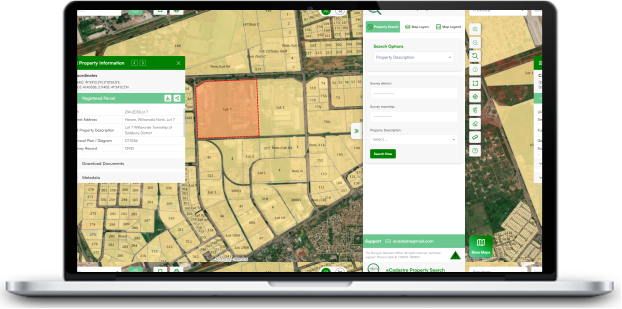
The Property Search module is an independent feature of this portal which enables users to search for all surveyed land properties in Zimbabwe. This module furnishes users with property information, including site plans, enhancing accessibility to comprehensive data for informed decision-making.

Survey records
Survey records comprise documents indicating that a property has undergone surveying and received approval. The documents facilitate title registration

eLodgements
eLodgement is a dedicated module that facilitates the lodgement of digital survey records for approval by the SG office. This module can only be accessed by land surveyors.

survey examination
Survey Examination is an eCadastre application that gives land surveyors the ability to track the status of their lodged survey records. It can only be accessed by land surveyors.
Property Search
The primary eCadastre module enables users to navigate the cadastral database, accessing property particulars, diagrams, general plans, and associated documentation. It serves as a vital tool for surveyors,
conveyancing professionals, and other land experts to retrieve crucial information to aid their business.
Additionally, it facilitates searching and viewing of spatial survey data, encompassing survey marks, suburb boundaries, roads, and addresses. Users can swiftly access property records via the portal's homepage search feature,
displaying pertinent details on a property card, and employ various criteria for land parcel searches and this includes:
Full property description
Survey record number
General plan/diagram number
Farm name (if the property is a farm)
Survey Records
The eCadastre system gives users access to survey records. These are critical products that
are indispensable in land administration especially title registration. These documents are
produced by cadastral surveyors as part of every survey work. They are then lodged and
approved by the SG office as evidence of land registration.
The survey records are one of the main reason different stakeholders visit the SG
offices. This portal gives users access to all the documents that are in the survey records.
The following table is list of the key survey records, the description and a sample of each.
Document Type
Description
Download Sample
Survey Diagram
A document containing geometrical, numerical and verbal representations of a piece of land

General Plan
A plan, prepared from a land survey, which shows the relative positions, boundaries, and dimensions of two or more pieces of land (such as subdivisions or stands), and which is signed and approved by the Surveyor-General.
DSG 1/96 Certificate
A dispensation certificate from local authority or physical planning to permit the survey
Permit
A permit to subdivide or consolidate any property granted in terms of section 41 of the Planning Act
Working plan
A diagram drawn to scale that shows the existing survey points and also depicts the new survey
Acknowledgement letter
Letter prepared and sent by the SG to acknowledge receipt of survey records lodged by the surveyor
Report on survey
A report of the survey carried out whether its a new survey or re-survey
Survey Records
Price Range
$2.00 - $10.00
eLodgment
Electronic lodgement is the process of submitting a survey records for approval to the
SG office in digital format. The eCadastre portal facilitates the lodgement of all
survey documents electronically for registered land surveyors only through the
eLodgement module . The documents formats are specified as a guide for the land
surveyor. Digital lodgement benefits the profession by ultimately providing, inter alia,
a more efficient examination of lodged records and documents, a shorter examination
period, and improved availability of survey and cadastral data. The SG offices
themselves gains improved service delivery, reduction in the required storage space,
improved accuracy of the spatial database, and a more client-focussed service.
The following is a list of documents that can be lodged on this portal. Survey
technicians can also submit documents on behalf of land surveyors through an
authorisation system using the mobile phone OTP.
Check List
Calculations
Coordinate list
Diagram/General plan
Field notes
Instruction
Survey Examination
The Surveyor-General shall examine the survey records when the examination fee prescribed in terms of section 10 of the Act has been paid. The examination process entails thorough checks of the survey records to assess the technical and non-technical aspects of the survey for land registration purposes.
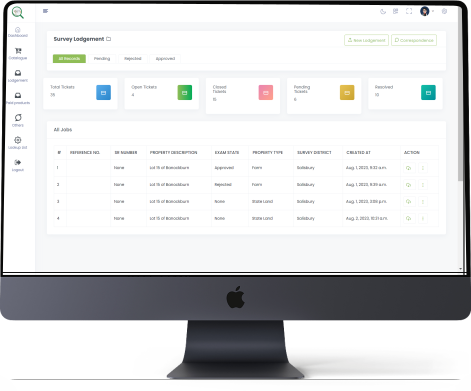
The eCadastre Examination module facilitates real-time tracking of the examination processes. At any point, the land surveyor will know the status of their lodged survey records. Return to Surveyor (RTS) notifications are done through a correspondence feature of the Examination module. A land surveyor can also check all their previous lodgements. This module is available to land surveyors only. The workflow is outlined below:
Stage 1: Check List
Stage 2: Calculations
Stage 3: Coordinate list
Stage 4: Diagram/General plan
Frequently Asked Questions
-
 What is a title survey?
A survey operations executed with a view to the registration of any real right in or to land or to the relocation of beacons, and includes the preparation of relevant survey records as defined in section 66.
-
 What is a property?
Any land which is described in any deed of grant or transfer or other certificate of title as a single piece of land.
-
 What is a land surveyor?
A person who is recognized as a land surveyor for the purposes of the Land Survey Act [Chapter 20:12].
-
 Who is the Surveyor-General (SG)?
The Surveyor-General referred to in the Land Survey Act [Chapter 20:12].
-
 What is a reference mark?
A survey mark of permanent construction placed by a land surveyor or under the direction of the Surveyor-General.
-
 What is registration?
In relation to any land, means a registration of any real right in or to such land in accordance with the provisions of the law relating to the registration of deeds.
-
 Can I access all the survey records?
All the records in the custody of the SG are public records and can therefore be accessed by anyone with interests.
-
 What is a stand?
Every piece of land registered as a stand, lot or plot in the Deeds Registry, and includes a stand or lot forming a portion of a piece of land laid out as but not proclaimed a township, or a portion of such stand or lot.
-
 What is a township?
A group of pieces of land which are used for residential, industrial, commercial or similar purposes, or are intended or likely to be used for any such purpose.
-
 Can I access the eLodgement module?
The eLodgement module can only be accessed by registered surveyors or a survey technician through rights granted by a registered surveyor.
-
 Can I access the examination module?
The examination module can only be accessed by registered surveyors or a survey technician through rights granted by a registered surveyor.
-
 Can I still visit the SG offices to buy hardcopy survey records?
Yes, anyone can still visit the SG's office for any services or products. Access is not limited to this portal only.