


eCadastre Resources: Your Guide to a Better Experience
Discover all the events, blog posts, videos, documents, and answers to your questions right here, in one convenient place.
Notify me when there are updates

Sample Documents
Get all the sample documents from the eCadastre system
Document Type
Description
Download Sample
Survey Diagram
A document containing geometrical, numerical and verbal representations of a piece of land

General Plan
A plan which, representing the relative position and dimensions of one or more pieces of land
DSG 1/96 Certificate
A dispensation certificate from local authority or physical planning to permit the survey
Permit
A permit to subdivide or consolidate any property granted in terms of section 41 of the Planning Act
Working plan
A diagram drawn to scale that shows the existing survey points and also depicts the new survey
Acknowledgement letter
Letter prepared and sent by the SG to acknowledge receipt of survey records lodged by the surveyor
Report on survey
A report of the survey carried out whether its a new survey or re-survey
Video Library
This is a collection of videos that will help you understand the benefits of the eCadastre, if you have any questions, please don't hesitate to contact us.
Legal Documents & Acts
Access important legal documents, acts, and regulations related to cadastral and land management in Zimbabwe.
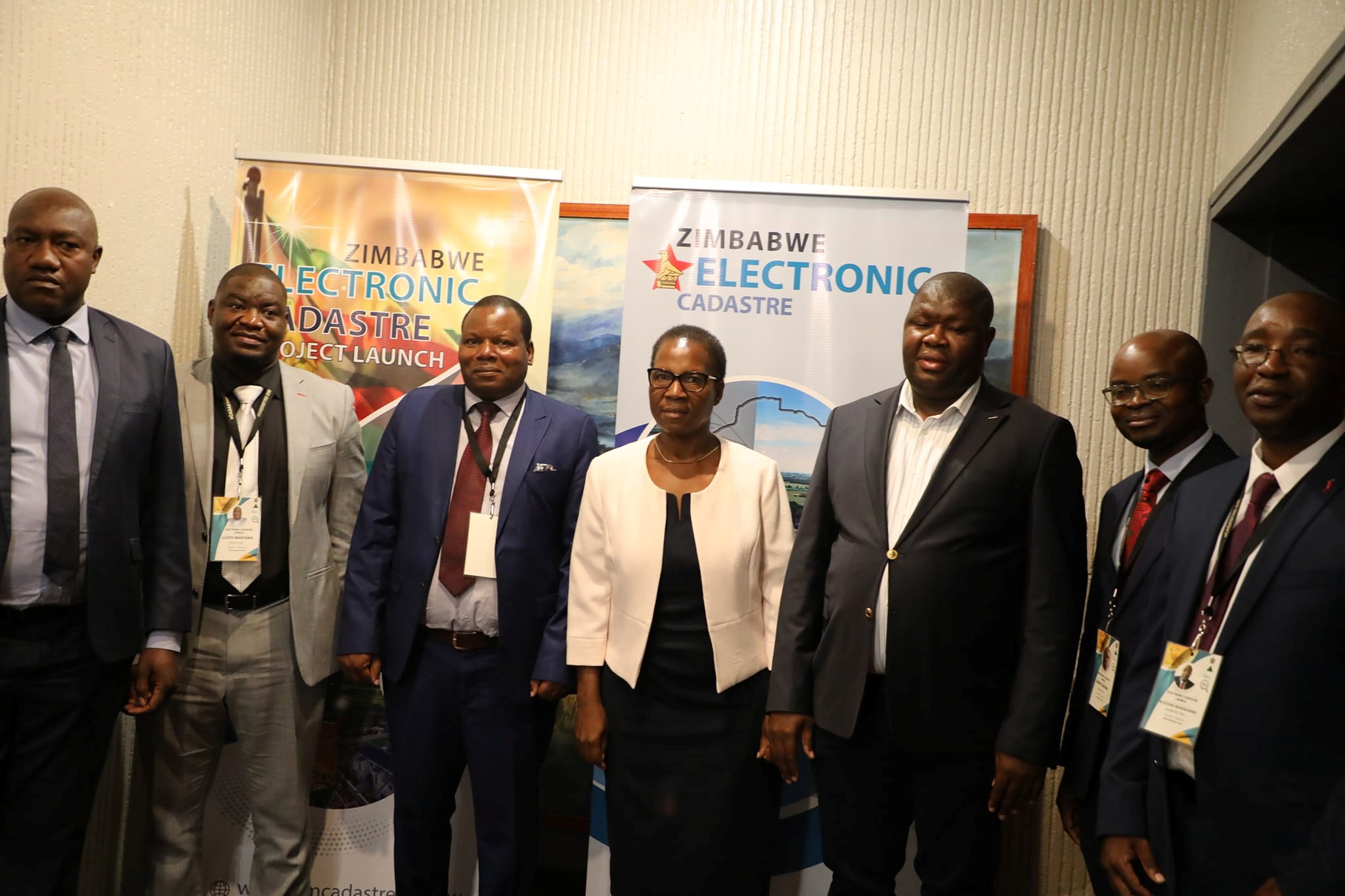
The Electronic Cadastre Project Launch Event
The Ministry of Land and Rural Resettlement (MLRR) (now called Ministry of Lands, Agriculture and Rural Resettlement) developed project: Support to the Ministry of Lands and Rural Resettlement 2014 to 2016 Action Plan. The main objective of the project was to assist the MLRR accelerate the rehabilitation of the land sector as a prerequisite for recovery and development of agriculture and other land based economic sectors.








The Electronic Cadastre Project Workshops
Description
Lorem ipsum dolor sit amet consectetur. Id consequat euismod adipiscing laoreet non ut habitant blandit purus. Donec vitae porttitor tempor magna mattis etiam. Lorem ipsum dolor sit amet consectetur. Id consequat euismod adipiscing laoreet non ut habitant blandit purus. Donec vitae porttitor tempor magna mattis etiam.
14 Photos & Videos

The Electronic Cadastre Project Launch Event
Description
The Ministry of Land and Rural Resettlement (MLRR) (now called Ministry of Lands, Agriculture and Rural Resettlement) developed project: Support to the Ministry of Lands and Rural Resettlement 2014 to 2016 Action Plan. The main objective of the project was to assist the MLRR accelerate the rehabilitation of the land sector as a prerequisite for recovery and development of agriculture and other land based economic sectors.
The Electronic Cadastre Project Workshops
Description
Lorem ipsum dolor sit amet consectetur. Id consequat euismod adipiscing laoreet non ut habitant blandit purus. Donec vitae porttitor tempor magna mattis etiam. Lorem ipsum dolor sit amet consectetur. Id consequat euismod adipiscing laoreet non ut habitant blandit purus. Donec vitae porttitor tempor magna mattis etiam.
14 Photos & Videos
Our Stakeholders

Teamwork divides the task and multiplies success! , the eCadastre project is being implemented by the efforts of highly skilled and experienced personnel. The above team from left to right: - Front row (left to right): P. Chitewe, P. Mtetwa, B. Munakamwe, L. Manyema, R. Mupondi, E. Guvaza, B. Gumbo, D. Alizhibhowa, T. Mudekwa, J. Siziba Back row (left to right): R. Mudunge, P. Bvekwa, M. Mashonganyika, C. Taruvinga, D. Gano, M. Manyema, S. Muchena, E. Marume, S. Murindagomo, M. Tagarira, C. Ndambakuwa.
The project is being implemented through consulting different stakeholders who include but not limited to The Department of the Surveyor General , Council of Land Surveyors , Department of deeds, Companies and Intellectual Property, Zimbabwe Institute of Geomatics , Zimbabwe Institute of Regional and Urban Planners , Real Estate Institute of Zimbabwe , Survey institute of Zimbabwe , Association of Mining Surveyors , Zimbabwe Local Government, Public Works and National Housing and Bankers Association of Zimbabwe .
Effective governance strengthens national development and service delivery. The eCadastre
project is being implemented in close collaboration with state and local government institutions
to modernize land administration, improve transparency, and enhance inter-agency coordination.
Through digitization and process integration, government entities are empowered to deliver
faster, more reliable, and accountable services to citizens.
The project works with key public sector stakeholders including The Department of the Surveyor
General, Ministry of Lands, Agriculture, Fisheries, Water and Rural Development, Ministry of
Local Government and Public Works, Deeds Registry, Zimbabwe Revenue Authority, Urban and
Rural Local Authorities, Physical Planning Departments, and other regulatory agencies.
Integration across these institutions ensures secure land records management, streamlined
approvals, improved revenue collection, and strengthened land governance frameworks at both
national and local levels.
Professional expertise drives innovation, accuracy, and sustainability in land administration
systems. The eCadastre project actively engages industry groups and technical professionals to
ensure the platform aligns with international standards, regulatory frameworks, and best
practices in surveying, mapping, planning, valuation, and property development.
Stakeholders include the Zimbabwe Institute of Geomatics, Survey Institute of Zimbabwe,
Council of Land Surveyors, Zimbabwe Institute of Regional and Urban Planners, Real Estate
Institute of Zimbabwe, Association of Mining Surveyors, Law Society of Zimbabwe, financial
institutions, valuation professionals, and ICT specialists. Their involvement strengthens technical
validation, supports compliance with professional standards, enhances data integrity, and
promotes continuous system improvement.
Secure land rights and efficient property transactions are fundamental to economic growth and
investment confidence. The eCadastre project provides business owners with streamlined access
to accurate land information, simplified property registration processes, and improved
transparency in land-related transactions.
The system supports developers, investors, financial institutions, construction companies,
agricultural enterprises, mining companies, and small-to-medium enterprises by reducing
processing times, minimizing disputes, and enabling secure collateralization of property assets.
By improving certainty and efficiency within the land administration ecosystem, eCadastre
enhances the overall ease of doing business and promotes sustainable economic development.
Glossary of terms
The terms provided here relate to the field of Land Surveying and Mapping. Please note that although great effort has been made to capture all presumed relevant and important terms, the glossary of terms is not exhaustive and will continuously be updated.
A
Acquisition of land
Land which may be bought back or received by the Crown, Government instrumentalities or local governments for public purposes. Owners are recompensed at the land's current market or assessed value.
ACRES Australian Centre for Remote Sensing
Australia's major earth resource satellite reception and processing facility.
Active sensing
Remote sensing methods that provide their own source of electromagnetic radiation for illumination, for example, radar.
Advisory panel
The Land Administration Act 1997 provides for the Minister to appoint an advisory panel to advise on any matter. The panel is expected to be used mostly to adjudicate between competing applicants for a lease or purchase of Crown land. It will not have the decision-making powers of the Land Board under the 1933 Act.
AFN Australian Fiducial Network
A network of permanent GPS satellite receivers, developed by AUSLIG for scientific and surveying applications, used as the primary framework for the Geocentric Datum of Australia (GDA).

B
Boundary Adjustment Survey
A survey conducted to legally redefine the boundaries of properties, typically occurring when two adjacent property owners agree to a change that modifies their respective property lines.
Baseline Survey
An initial survey conducted to gather conditions before a project begins, used for comparison after the project completion or during monitoring.
Benchmark
A permanent reference point with a known elevation used in surveying to establish the elevation of other points in relation to sea level.
Bearing
The angle of a line in relation to a reference direction, typically expressed in degrees, used to describe the direction of property lines or survey lines in a legal description.
Boundary Survey
A survey that determines the exact location of property lines, establishing the boundaries of a parcel of land, often used for legal and development purposes.
Building Permit Survey
A type of survey required by local authorities prior to issuing a building permit, ensuring proposed construction complies with zoning laws, setback requirements, and land-use regulations.
C
Cadastre
A public record or register that includes details about land parcels, including their ownership, boundaries, land use, and any associated rights or restrictions. A cadastre serves as a foundational component of land administration and property taxation systems, and in an eCadastre context, it leverages digital technologies to improve data accessibility, management, and analysis for stakeholders.
Cadastral Survey
A survey that defines land parcels for the purpose of property ownership, taxation, and land use regulation, providing essential data for land registries.
Control Point
A fixed point with known geographic coordinates that serves as a reference for other measurements in surveying, crucial for maintaining accuracy in both vertical and horizontal positioning.
Control Survey
A survey that establishes a network of control points with known coordinates, which serve as a reference for future surveys and mapping projects.
Coordinate System
A mathematical system that uses coordinates to specify locations on the Earth's surface, essential for mapping and spatial analysis, enabling surveyors to accurately represent and communicate geographic information.
Control Point
A fixed point with known geographic coordinates that serves as a reference for other measurements in surveying, crucial for maintaining accuracy in both vertical and horizontal positioning.
D
Datum
A reference point or surface from which measurements are made in surveying and mapping. It provides the basis for establishing the elevation and positional framework within eCadastre systems, ensuring consistency and accuracy in land data representation.
Deed
A legal document that formally transfers ownership of real property from one party to another. In eCadastre systems, deeds are crucial for recording property transactions and maintaining an accurate record of ownership in the cadastral database.
Delineation
The act of outlining or defining the boundaries of a land parcel or property on a map or within the physical environment, often performed during surveys to ensure accuracy in cadastral documentation and land registration processes.
Dispute Resolution
The process of resolving disagreements regarding land boundaries, ownership, or rights, often facilitated through legal frameworks or mediation strategies. A well-maintained eCadastre can provide transparent documentation to support the resolution process.
Digital Elevation Model (DEM)
A 3D representation of the Earth's surface created from terrain elevation data. DEMs are used in land surveying, planning, and eCadastre systems to analyze topography, assess land suitability for various uses, and manage land-related projects effectively.
E
Easement
A non-fee land title right or interest that allows someone to use another person's land for a specific purpose, such as access or utilities.
Easting
A coordinate value representing the longitudinal position of a point in a coordinate system.
Egress
The right to exit or emerge from a property, typically referring to a legal right of access to a public road or pathway.
Elevation
The vertical height of a point above a defined reference datum, such as sea level or a local benchmark.
Equator
The standard parallel of 0 degrees latitude, an imaginary circle around the Earth equidistant from the North and South Poles.
Excepting
An informative term used to indicate exclusion or withdrawal of a particular item or area from a description or agreement.
Extension of
Refers to the continuation of a defined line, boundary, or course.
F
Frac
An abbreviation for fraction or fractional, indicating a portion of a whole unit.
Flowage Line
A defined contour line used for water control purposes, typically indicating the maximum water level for a reservoir or controlled water body.
Fractional lot
A non-aliquot PLSS (Public Land Survey System) section division land remnant, typically found along the north and west township lines. These lots are smaller than the standard aliquot divisions due to irregularities in the township boundaries or other factors.
From
An informative term indicating the origin or starting point of a measurement, description, or action. It also implies a sense of continuance or progression.
Frontage
The land boundary that abuts or directly faces a roadway, waterway, or other significant feature. Frontage often has implications for access, visibility, and property value.
G
GLO
An abbreviation for General Land Office, a former U.S. government agency responsible for managing public lands. It is now known as the Bureau of Land Management (BLM).
Government lot
A non-aliquot riparian land remnant created by the PLSS survey and designated on an official GLO/BLM Township Plat. These lots are typically found along rivers or waterways and are smaller than the standard aliquot divisions due to the irregular boundaries of water bodies.
Grade
The surface level of the ground or the rate/degree of slope. It can refer to the natural topography or the engineered slope of a road, building site, or other constructed feature.
Grantee
The person(s) or legal entity receiving title rights and/or interests from a grantor. The grantee becomes the new owner or holder of the property or rights being conveyed.
Grantor
The person(s) or legal entity granting title rights and/or interests to a grantee. The grantor is the original owner or holder of the property or rights being transferred.
H
Half
Indicates a division into two equal areas, except in the case of PLSS (Public Land Survey System) divisions, where "half" refers to an aliquot partition as defined by S.59.62 of the Wisconsin Statutes.
Heretofore
A legal document that formally transfers ownership of real property from one party to another. In eCadastre systems, deeds are crucial for recording property transactions and maintaining an accurate record of ownership in the cadastral database.
Delineation
The act of outlining or defining the boundaries of a land parcel or property on a map or within the physical environment, often performed during surveys to ensure accuracy in cadastral documentation and land registration processes.
Dispute Resolution
The process of resolving disagreements regarding land boundaries, ownership, or rights, often facilitated through legal frameworks or mediation strategies. A well-maintained eCadastre can provide transparent documentation to support the resolution process.
Digital Elevation Model (DEM)
A 3D representation of the Earth's surface created from terrain elevation data. DEMs are used in land surveying, planning, and eCadastre systems to analyze topography, assess land suitability for various uses, and manage land-related projects effectively.
I
I.D
An abbreviation for inside diameter, referring to the measurement of the interior width of a hollow object, such as a pipe or cylinder.
Ingress
The right to enter a property, typically referring to a legal right of access from a public road or pathway. It ensures that occupants have a means of accessing the property.
Included Angle
An interior angle formed by the intersection of two lines enclosing a polygon or land parcel boundaries. It is measured in degrees and is typically smaller than the exterior angles of the polygon.
Interior Angle
Another term for included angle, referring to an angle formed within a polygon or enclosed area by the intersection of two sides.
Intersection
The point where two lines, roads, or other features meet or cross. It is often a location of increased traffic or interaction.
L
Lane
A narrow traveled way, typically unpaved or less developed than a road, often created by usage rather than formal construction. Lanes may serve as access routes or secondary pathways in rural or less populated areas.
Landmark
A prominent artificial or natural object that serves as a reference point for defining lands or boundaries. Landmarks can be man-made structures, natural features, or boundary corner monuments of public record.
Latitude (dN)
The latitudinal interval between points, expressed as an angular arc distance north or south of the Equator along a meridian of longitude. It is typically measured in degrees, minutes, and seconds.
Line
A boundary, course, or extension between points, which may consist of straight or curvilinear segments. Lines are used to define property boundaries, survey traverses, or other spatial relationships.
Link
A lineal measurement equivalent to 1/100th of a chain, equal to 0.66 feet or 7.92 inches. It is a traditional unit of measurement used in surveying and land measurement.
M
Magnetic north
The direction indicated by the north-seeking end of a compass needle, which is influenced by the Earth's magnetic field. It differs from true north, which is the direction along the Earth's surface towards the geographic North Pole.
Map
A graphical representation of land or a geographic area, drawn to scale and showing features such as terrain, roads, buildings, and natural features. Maps are used for navigation, planning, and understanding spatial relationships.
Main Channel
The navigable channel of a waterway, which may not necessarily be the center of the waterway. It is the deepest and most suitable route for boat traffic.
Mark
A defined object, point, or line of reference used for surveying, navigation, or other purposes. Marks can be natural features, man-made structures, or specially placed markers.
Meander line
A line established along a waterway for the purpose of surveying and mapping riparian land frontage. Meander lines follow the general course of the waterway and are used to determine property boundaries and water rights.
N
Navigable
In the context of Wisconsin, a waterway is considered navigable if it is capable of floating a canoe at any time of the year. More generally, a navigable waterway is one that has a defined bed and banks and is capable of being used for transportation or travel by watercraft.
Normal To
Refers to a direction or line that is perpendicular or at right angles to another line or radial to a curve. It indicates a 90-degree relationship between the two lines or directions.
Northerly, etc.
A general directional term used to indicate a general direction towards the north or a northward tendency. It is often used in reference to another feature or direction, such as "northerly from the point of beginning."
Northing
A coordinate value representing the northward position of a point in a coordinate system, typically measured in meters or feet from the equator. It is the vertical component of a grid reference.
Digital Elevation Model (DEM)
A 3D representation of the Earth's surface created from terrain elevation data. DEMs are used in land surveying, planning, and eCadastre systems to analyze topography, assess land suitability for various uses, and manage land-related projects effectively.
O
O.D.
An abbreviation for outside diameter, referring to the measurement of the exterior width of a hollow object, such as a pipe or cylinder. It is the opposite of inside diameter (I.D.).
Of
An informative term used to indicate inclusion, association, or possession. It can connect a part to a whole, an item to a group, or an object to its owner.
Offset
A perpendicular interval or distance measured from a reference line or feature. It is often used to establish parallel lines or boundaries, or to locate points relative to existing features.
On
An alternative term for "along" or "upon," indicating a position or movement along a surface or line. It suggests a continuous relationship between the object and the reference.
One half
Another way of saying "half," indicating a division into two equal parts. It can refer to a physical division of an object or a mathematical division of a quantity.
P
Parallel with
Indicates a relationship of separation by equal interval or spacing between two lines or features. The lines maintain a constant distance from each other along their entire length.
Parcel
An area of land enclosed by defined boundaries, typically identified by a unique parcel number or identifier. Parcels are the basic units of land ownership and taxation.
Part of
An informative term used to indicate division or protraction, suggesting that the item or area being described is a subset of a larger whole. It implies a partial or fractional relationship.
Perch
A lineal measurement equal to 16.5 feet, also known as a rod. It is a traditional unit of measurement used in surveying and land measurement.
Plat
A map of a survey, typically representing a subdivision or development plan. Plats show the layout of streets, lots, and other features within a defined area.
R
Radial
A line radiating from the center of a circle, extending outward in any direction. Radial lines are often used to define angles or to divide a circle into sectors.
Random Line
A non-monumented trial or temporary survey line used for preliminary measurements or to establish a general direction. Random lines are not considered permanent or legally binding boundaries.
Range
A north/south tier of PLSS townships, numbered consecutively east or west from a principal meridian. Ranges are part of the rectangular land division system used in the United States.
Reference Mark
Same as Mark above, typically a monumented or marked point used for surveying or navigation. Reference marks provide known reference points for measuring distances or angles.
Reserved
Refers to existing title rights and/or interests that are retained by a party or not included in a conveyance. Reserved rights or interests remain with the original owner or holder.
T
Thence
Indicates a continuation from a previously mentioned point or direction.
Thread
The centerline of a waterway at its normal water level.
Tie
A measurement of direction and distance from a defined point to a nearby object, typically used for landmark preservation.
To
Indicates a termination or exclusion from a previously mentioned point or direction.
Township
A Public Land Survey System (PLSS) unit containing 36 sections.
W
Waterway
A natural or artificial channel that carries water, such as a lake, pond, river, stream, creek, or canal.
Witness Corner
A reference monument used to mark the location of an inaccessible corner, typically established on the related boundary by a directional and distance offset. It serves as a substitute for the actual corner, providing a means to locate the corner indirectly.
Y
Yard
A unit of length equal to 3 feet or 36 inches. It is commonly used in the United States and the United Kingdom for measuring distances and dimensions.
Yd:
The abbreviation for yard or yards. It is commonly used in written documents and measurements to represent the unit of length.